
How to Play Kalimba: Ultimate Beginner’s Guide with Easy Songs
Curious about how to play kalimba? This beautiful little instrument is easier to learn than you might expect. With a few simple techniques and beginner-friendly songs, you can start playing right away!

Learning how to play kalimba is easier than you might think. This small, handheld instrument, often called a “thumb piano,” creates soothing, melodic sounds that make it perfect for beginners and experienced musicians alike. With just a few basic techniques, you can start playing simple melodies and even some well-known songs within minutes.
In this guide, we’ll cover everything you need to get started. You’ll learn how to read kalimba tabs, hold the instrument comfortably, and play your first melodies with confidence. We’ll also walk through easy, beginner-friendly songs, simple chords and answer the most common questions related to learning how to play the kalimba.
Whether you have a 17-key kalimba or a smaller 8-key version, this step-by-step guide will help you build a solid foundation and enjoy the calming tones of this beautiful instrument.
This post is all about how to play kalimba.
This post may contain affiliate links. We may earn a small commission at no extra cost to you—thank you for supporting what we do. We only share offerings we truly believe in.
What is a Kalimba?
The kalimba, also known as a thumb piano, is a small handheld instrument with a warm, soothing sound. It belongs to the mbira family of instruments, which originated in Africa over 3,000 years ago. Traditionally, people used mbiras in storytelling, celebrations, and spiritual ceremonies.
The modern kalimba was popularized in the 1950s by Hugh Tracey, an English ethnomusicologist. After studying African music extensively, he designed a portable, standardized version of the instrument. His work helped bring the kalimba to audiences around the world, making it easier to learn and widely accessible.
A typical kalimba is made from a wooden body with thin metal tines attached on top. You play it by plucking the tines with your thumbs, creating soft, bell-like tones. Its compact size makes it easy to carry, and beginners can pick up simple melodies quickly.
Today, the kalimba is enjoyed globally for meditation, relaxation, and creative expression. Its gentle tones are also used in sound baths and sound healing sessions, where calming vibrations help deepen rest and release stress.
Types of Kalimba
Kalimbas come in different sizes, tunings, and designs. Choosing the right one depends on your skill level and how you want to play.
Mini Kalimbas (8 Keys)
Mini kalimbas usually have 7 or 8 keys and are tuned to a simple diatonic scale, often C major. They’re lightweight, portable, and very beginner-friendly. Their limited range makes them perfect for relaxation, simple playing or for beginners, but they’re less versatile for playing complex songs.
Standard Kalimbas (17 keys)
The 17-key kalimba is the most popular type for beginners and musicians. It’s usually tuned to C major, which makes it easy to follow online tutorials and tabs. The 15-key kalimba is also common, producing slightly lower, warmer tones. These standard kalimbas are versatile, allowing you to play melodies, harmonies, and a wide range of songs.
Diatonic vs. Chromatic Kalimba
Most kalimbas are diatonic, meaning they’re tuned to a single major scale. This makes them easier to learn since nearly every note sounds good together. A chromatic kalimba, on the other hand, includes extra tines for sharps and flats. This lets you play in any key and explore more advanced melodies, but it can be much more challenging for beginners.
Hollow-Body vs. Flat-Board Kalimba
A hollow-body kalimba has a wooden sound box and usually includes a sound hole. It produces a louder, fuller tone and can create a fun “wah-wah” effect by covering and uncovering the hole. This is generally the most common style.
A flat-board kalimba is made from a solid wooden board without a hollow chamber, resulting in a softer, gentler sound. Flat-board kalimbas are lighter and often preferred for meditation or quiet practice.
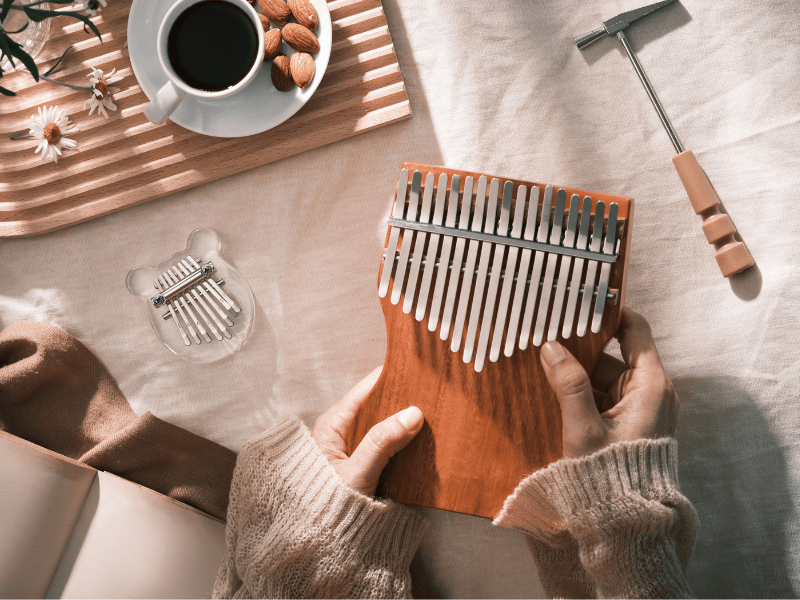
How to Play Kalimba: Essential Techniques
Learning how to play the kalimba is simple, but using the right techniques from the start makes a big difference. Here are the essentials to help you get started.
Holding the Kalimba
Rest the back of the kalimba in your palms and let your thumbs rest lightly on top of the tines. Keep your grip steady but relaxed so your hands don’t tense up. You can hold the kalimba upright or tilt it slightly toward you. Experiment to find the most comfortable position.
Plucking the Tines
Use the pads of your thumbs to pluck the metal tines gently. Avoid using your nails, as they can create a sharper, less warm tone.
Pull your thumbs downward and let the notes ring naturally. Try to stay relaxed, forcing the sound will make playing harder and less smooth.
Start with Single Notes
Begin by plucking one tine at a time and listening carefully to each sound. Most 17-key kalimbas are tuned to C major, which means almost every note will sound pleasant together. Playing slowly at first helps you get familiar with the layout of the keys and their tones.
Alternating Your Thumbs
Practice switching between your left and right thumbs when plucking. Alternating helps you create smooth rhythms and build coordination between both hands. Start with simple patterns, then gradually increase speed as you feel more confident.
Practicing Simple Patterns
Pick three or four notes and create small, repeating patterns. Repetition helps train your thumbs to find the right tines without looking down. Start slow and stay consistent. Accuracy matters more than speed when you’re learning.
Creating Harmonies
Once you’re comfortable playing single notes, try plucking two tines at the same time. Begin with notes next to each other for a soft, balanced sound, then experiment with wider intervals for a richer, layered effect. Playing harmonies adds depth and makes melodies sound more complete.
Tuning Your Kalimba
Most modern kalimbas, especially 17-key models, are tuned to C major by default. Over time, though, the tines can shift slightly and fall out of tune. To fix this, use a chromatic tuner (either a physical device or a tuning app.)
Play each tine and compare the pitch to the correct note. If the sound is too low, gently tap the tine upward with a kalimba tuning hammer to raise the pitch. If it’s too high, tap it downward to lower it. Check each note carefully as you go, and retune your kalimba regularly to keep it sounding its best.
How to Read Kalimba Tabs
Kalimba tabs use numbers to represent the notes instead of traditional sheet music. For tuning and examples, we will focus on C major since it’s the standard tuning.
The numbers start from 1 for the lowest note in the center. Lower notes are usually on the left, and higher notes on the right, with the notes alternating as you move outward from the center.
Many kalimbas also have numbers or letters engraved or printed on the tines, which makes following tabs much easier for beginners.
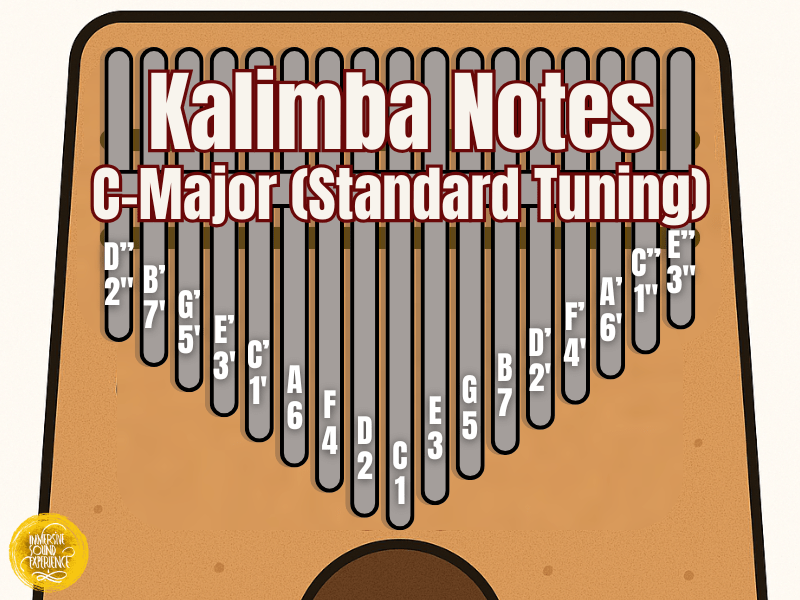
Understanding Where “1” Is on Your Kalimba
When you read kalimba tabs, the number “1” does NOT mean “the first tine on the far left.” Instead:
• On most kalimbas, “1” = the lowest note on your instrument.
• This is usually the longest tine in the center, tuned to C if your kalimba is in C major.
• From there, the numbers move outward, alternating left and right as you go up the scale.
For example:
• The center tine = 1 (C)
• The next tine to the left = 2 (D)
• The next tine to the right = 3 (E)
• Then left again = 4 (F)
• Then right = 5 (G)
• And so on…
So the notes zigzag as you move upward, which matches how you play with alternating thumbs.
Understanding Octaves
On an 8-key kalimba, you have just one octave plus one extra note. The numbering goes 1 through 7 → C, D, E, F, G, A, B, and the 8th key is usually high C (1′). Because it only has these eight notes, tabs for 8-key kalimbas stay simple and don’t include higher octave notes.
On a 17-key kalimba, you have two full octaves. After 7 (B), the numbering starts over in the higher octave:
• 1′ = high C
• 2′ = high D
• 3′ = high E
• …and so on.
In tabs, the prime symbol (′) tells you to play the higher octave note, which is usually found on the right side of the instrument.
Understanding Chords
When you see two or more numbers in parentheses, like (3 5), that means you pluck both tines at the same time.
• Example: (3 5) → Play E and G together.
How to Play Kalimba Songs for Beginners (Easy Songs)
When learning how to play the kalimba, starting with simple and familiar songs makes practice easier and more enjoyable. These beginner-friendly songs work well on both 8-key and 17-key kalimbas tuned to C major.
They use a simple, repetitive melody. Perfect for practicing single-note plucking and hand coordination.
Twinkle, Twinkle, Little Star
You can also play the Alphabet song or “Baa Baa Black Sheep” which follow the same tune.
Notes: C C G G A A G · F F E E D D C
Numbers: 1 1 5 5 6 6 5 · 4 4 3 3 2 2 1
Notes: G G F F E E D · G G F F E E D
Numbers: 5 5 4 4 3 3 2 · 5 5 4 4 3 3 2
Notes: C C G G A A G · F F E E D D C
Numbers: 1 1 5 5 6 6 5 · 4 4 3 3 2 2 1
Happy Birthday
Notes: G G A G C′ B · G G A G D′ C′
Numbers: 5 5 6 5 1′ 7 · 5 5 6 5 2′ 1′
Notes: G G G E′ C′ B A · F′ F′ E′ C′ D′ C′
Numbers: 5 5 5 3′ 1′ 7 6 · 4′ 4′ 3′ 1′ 2′ 1′
Mary Had a Little Lamb
Notes: E D C D E E E · D D D · E G G
Numbers: 3 2 1 2 3 3 3 · 2 2 2 · 3 5 5
(repeat)
You Are My Sunshine
If you have an 8-key kalimba, you won’t have access to these higher-octave notes. In that case, simply play the lower octave version using the same note sequence without primes. The melody stays the same but will sound deeper and softer.
Notes: C′ E′ F′ G′ G′ G′ F′ G′ E′ E′
Numbers: 1′ 3′ 4′ 5′ 5′ 5′ 4′ 5′ 3′ 3′
Notes: E′ F′ G′ A′ C″ C″ B′ A′ G′
Numbers: 3′ 4′ 5′ 6′ 1″ 1″ 7′ 6′ 5′
Notes: C′ E′ F′ G′ G′ G′ F′ G′ E′ E′
Numbers: 1′ 3′ 4′ 5′ 5′ 5′ 4′ 5′ 3′ 3′
Notes: E′ F′ G′ A′ F′ F′ G′ E′
Numbers: 3′ 4′ 5′ 6′ 4′ 4′ 5′ 3′
Next Steps on How to Play Kalimba & Improve Your Skills
Once you’re comfortable with the basics of how to play the kalimba, the next step is building confidence and expanding your skills. Here are a few simple ways to keep improving.
Build Consistency
Short daily practice sessions (even 10 minutes a day) are better than longer, irregular ones. Over time, your muscle memory will improve, and your playing will sound smoother and more natural. Be patient with yourself.
Record Yourself Playing
Listening to your recordings can help you spot areas for improvement. It’s also encouraging to hear your progress over time.
Experiment with Improvisation
Once you know your scales, try creating your own melodies. Improvising helps you develop a deeper connection with the instrument and builds confidence.
FAQ about How to Play Kalimba
Is the kalimba easy to learn?
Yes! The kalimba is one of the easiest instruments to start with. Most beginners can play simple songs within a few days of practice.
Do I need to know how to read sheet music?
No. Kalimba tabs make learning easy, even if you can’t read sheet music. Tabs show you exactly which tines to pluck and when.
How many keys should I start with?
A 17-key kalimba tuned to C major is the most popular for beginners because most tutorials and tabs are designed for it. However, 7-key or 8-key mini kalimbas are great for meditation, sound healing, and simple melodies.
How often should I tune my kalimba?
Check your kalimba’s tuning every couple of weeks or whenever it sounds off. A tuner app and a kalimba tuning hammer make the process simple and quick.
Can I play any song on the kalimba?
Yes, but it depends on your kalimba type. A diatonic kalimba can play songs in its tuning, usually C major. A chromatic kalimba allows you to play more advanced pieces with sharps and flats.
How do I play chords on the kalimba?
Chords are created by plucking two or more tines at the same time. Start with neighboring notes for soft, balanced harmonies, then experiment with wider intervals to add depth to your melodies.
This post was all about how to play the kalimba.
Want to experience more with sound? Join our community through the newsletter or follow us on social media for sound baths and healing music insights.


